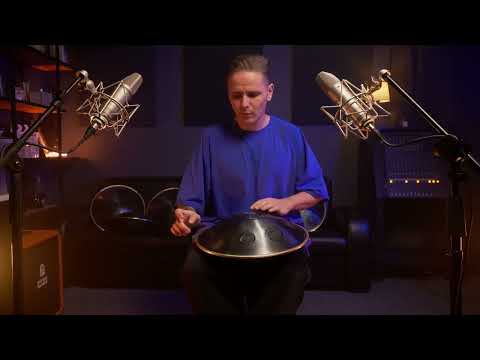

In the modern age, silence has become a rare commodity, yet for many of us, it is the silence itself that feels the loudest when we finally lay our heads on the pillow. We live in an era of "cognitive noise". The residual hum of blue light, the frantic rhythm of the city, and the internal monologue of a thousand unfinished tasks all make the cognitive noise we have in our brains. We try to drown it out with the sterile whir of fans or the loop of a digital white-noise machine, but these are often just auditory bandages. They mask the noise without addressing the underlying tension of the nervous system.
But there is an alternative that feels less like a machine and more like a return to something ancient. If you own a RAV Vast, you are not just in possession of a musical instrument; you are holding a precision-engineered tool for acoustic sedation. In a world addicted to blue light and cortisol, sleep has become the ultimate luxury. We spend billions on weighted blankets, melatonin supplements, and white noise machines that sound like static-heavy jet engines. Yet, we often overlook the most potent tool for nocturnal transition: harmonic resonance.
As a RAV Vast player, you aren't just holding a drum; you are holding a precision-engineered frequency generator. This guide will move past "relaxation" and into the technical application of the RAV Vast as a clinical tool for sleep induction.
When we move beyond the technical scales and the rhythmic "jams," we find that the RAV is uniquely designed to act as a bridge between the frantic "Beta" state of the day and the deep, restorative "Delta" state of a profound sleep.
The Physics of the Midnight Thrum
To understand why the RAV Vast is so uniquely suited for insomnia, one must first understand the physics of the "envelope" of sound it produces. Unlike a piano, where the hammer strikes a string and the sound begins to decay almost immediately, or a guitar, where the resonance is contained within a wooden box, the RAV Vast is a "living" steel vessel.
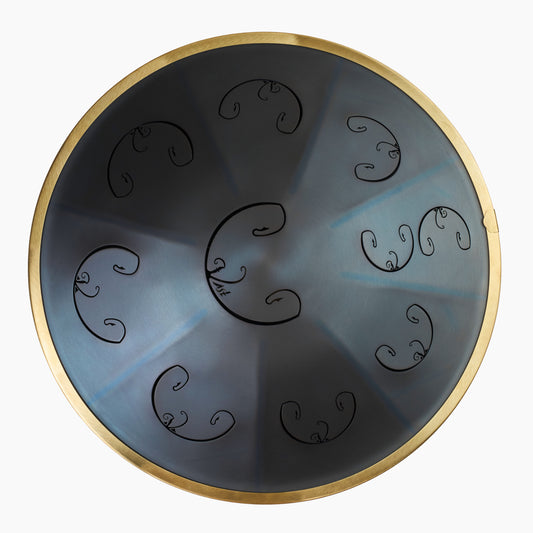
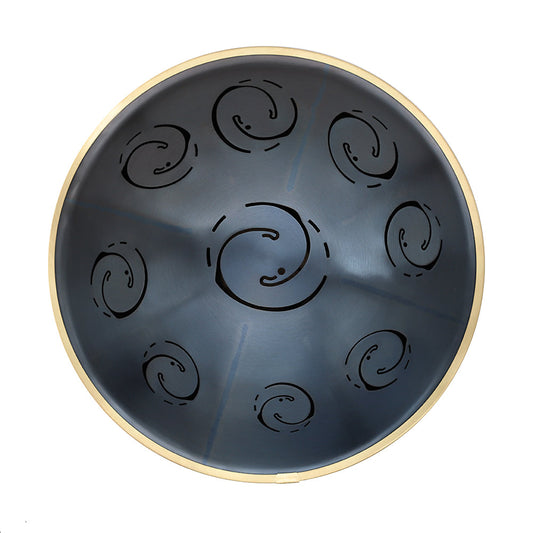
When you strike a tongue on a RAV, particularly on lower-frequency scales like the E Low Pygmy or the G Pygmy, you are initiating a complex series of vibrations. The patented "tongue-within-a-tongue" design means that a single strike doesn't just produce one note; it creates a fundamental frequency layered with its own perfect octaves and fifths. In the quiet of a bedroom, these frequencies do not just hit the ear; they move the air around your body.
This is where the science of Brainwave Entrainment begins. Our brains are highly sensitive to external rhythms. If we are surrounded by fast, jagged noises, our brainwaves stay in the "Beta" range. However, when we are exposed to the long, slow, oscillating "beating" of RAV harmonics, our brainwaves begin to mimic that frequency. By playing slowly (slower than a heartbeat), you are essentially whispering a command to your limbic system: It is safe to let go.

The History of the Lullaby: From Bronze to Steel
The concept of using metal resonance to induce sleep is not a modern "New Age" invention; it is a lineage that stretches back to the Bronze Age. Long before the invention of the RAV Vast, ancient civilizations in the East used "Singing Bowls" and deep-toned gongs to induce trance-like states. These cultures understood intuitively what we now know scientifically: certain frequencies have the power to "untie" the knots in the human spirit.
In the temples of the Himalayas, monks used the deep "Om" of a bronze bowl to stabilize the heart rate of practitioners. The RAV Vast is the evolution of this technology. While a singing bowl is limited to a single note, the RAV allows for a harmonic progression, a "lullaby" that can be customized to the listener’s emotional state. We are essentially taking the sacred geometry of ancient temple bells and folding it into a portable, steel form factor that fits on your bedside table.
Choosing Your Sedative: The Darker the Better
If we were to look at the RAV Vast catalog through the lens of a pharmacist, we would see that different scales serve different "medicinal" purposes. For the purpose of sleep, we want to avoid the "caffeine" of the brighter, major-key scales. The D Major, for example, while beautiful, might pique the brain's curiosity. They are "active" scales that encourage movement and joy, but you can still use brighter scales if you play with the intent that it is going to help you fall asleep. We will expand on the technique later.
For sleep, we require "Passive" scales. The E Low Pygmy is arguably the most potent sedative in the collection. Because E2 is such a deep, low frequency, its vibrations are felt as much as they are heard. Low-frequency sound has a documented effect on the vagus nerve, the "on-off switch" for our body's parasympathetic nervous system. When the vagus nerve is stimulated by these deep, thrumming vibrations, the body’s heart rate slows, and the production of cortisol begins to drop.
Then there is the G Pygmy, which offers a different kind of solace. It is a scale that feels grounded and "earthy". For many, insomnia is a feeling of being "ungrounded," of thoughts floating too high and too fast. The G Pygmy acts as an anchor. Its minor-pentatonic structure is intentionally "incomplete" in a way that feels ancient and resolving, leading the listener away from the complexities of modern life and back toward a primal sense of safety.
The Protocol: Moving from Sound to Silence
The transition from wakefulness to sleep is a delicate "fading out". To use the RAV effectively, the player must adopt a specific technique that differs from standard performance. This is a three-stage descent:

Phase One: The Clearing
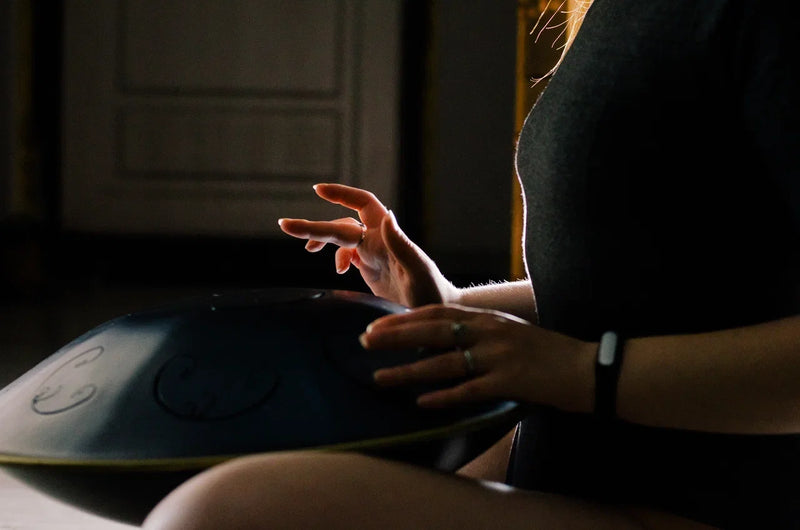
Imagine your room is filled with the "static" of the day. You place the RAV on a soft surface (perhaps directly on your duvet or a heavy pillow) to dampen the metallic "shimmer" and highlight the warm, woody core of the steel. You begin by striking the Ding, the central heart of the drum, once every ten to fifteen seconds. This isn't music; it is a pulse. You synchronize your breathing to this pulse: inhale as the sound blooms, and exhale as it decays into the shadows of the room.
Phase Two: The Descending Ladder
In music theory, higher pitches are often associated with alertness and tension, while lower pitches represent resolution and rest. You begin to play a very slow, downward progression. You start with the smallest tongues, striking them with the fleshy part of your thumb for the softest possible "attack," and gradually work your way down to the largest tongues. You are metaphorically walking your consciousness down a set of stairs, moving deeper into the "basement" of your mind where sleep resides.
Phase Three: The Binaural Fade
By striking two tongues that share a harmonic relationship (such as an E and its fifth, B) you create a "beating" frequency. In the stillness of the night, this creates a natural binaural beat that helps the brain cross the threshold from "Alpha" (relaxation) into "Theta" (the gateway to sleep). The last minute of the protocol should be almost silent, where the strikes are so soft they are almost felt rather than heard, until finally, the last vibration vanishes, leaving you in a silence that no longer feels loud, but heavy and welcoming.
The Biological Impact: Melatonin and the Steel Drum
While we often talk about "vibes," the impact of the RAV on sleep is deeply biological. When the brain enters the Theta and Delta states, it triggers the pineal gland to optimize melatonin production. Digital white noise, while constant, doesn't have the "tonal weight" to trigger this same response. The organic, analog decay of a RAV note mimics the natural sounds of the environment, sounds that our ancestors evolved to find comforting.
Furthermore, playing the RAV provides a gentle "tactile" workout. The fine motor skills required to strike the tongues gently act as a form of "moving meditation". It occupies the "monkey mind" just enough to stop it from worrying about tomorrow’s emails, but not so much that it requires intense cognitive effort. It is the musical equivalent of a rocking chair.
The "Dampened" Aesthetic: Engineering the Room
To truly turn a RAV into a sleep machine, one can also experiment with "acoustic engineering" within the home. A bare RAV in a tiled room will be too bright and reflective for sleep. Your bedroom, on the other hand, will result in better resonance.
Furthermore, the position of the instrument matters. While we usually play the RAV in our laps, for sleep, we want to minimize physical effort. Placing the RAV on a bedside table allows the player to reach out a single hand while already lying in a sleeping position. This ensures that when the "sleep switch" finally flips, there is no need to move the drum, stand up, or break the "Flow State" to get comfortable. You are already there.
The Modern Nomad’s Nightcap
As we move further into a digital-first world, the value of analog ritual becomes immeasurable. The RAV Vast is a bridge between the high-tech world of its construction and the prehistoric world of its sound. By incorporating the Sound-Sleep Protocol into your nightly routine, you are doing more than just playing music; you are reclaiming your right to rest.
The RAV is not just a drum for the stage or the park; it is a guardian for the bedroom. It is a reminder that in a world that never stops talking, the most beautiful thing we can create is the space for silence to return. So, the next time the night feels too long and your mind feels too loud, don't reach for your phone. Reach for your RAV. Strike the Ding, follow the decay, and let the steel carry you into the deep.