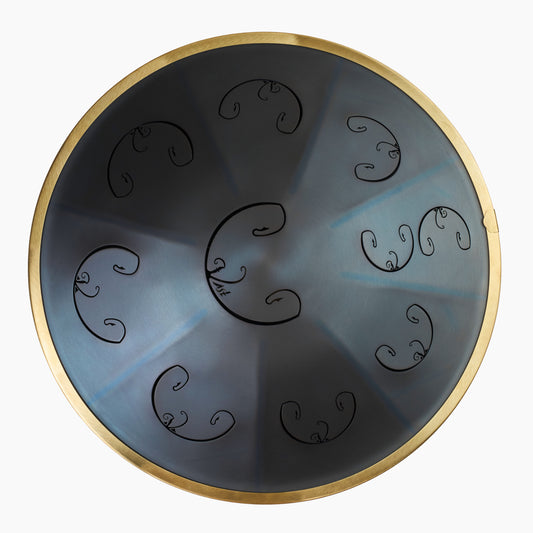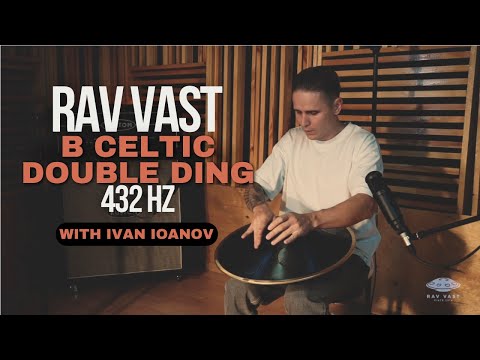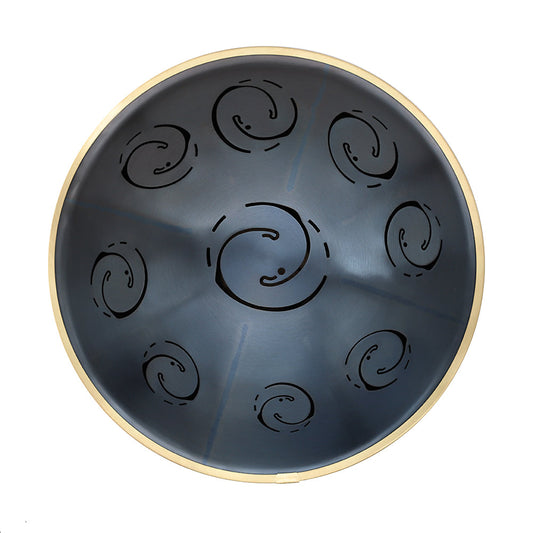

The RAV Vast and RAV Moon may seem mystical, but their rich, bell-like tones are really grounded in physics. In fact, sound is simply vibration moving through air or a solid medium. When you strike a RAV drum (a kind of steel tongue drum or handpan drum), the steel vibrates, sending pressure waves into the air. Each note on a RAV has many harmonics vibrating together. When you hit a note on RAV the result is a long, ringing sustain and a complex timbre. In physics terms, the mallet transfers energy to the instrument, making its material flex and oscillate. These oscillations create the beautiful overtones that give RAV drums their warm, resonant sound. This makes the RAV’s output as soothing and ideal for relaxation or meditation. Thus, the entrancing tones of RAV drums arise from well-understood acoustic effects and can be explained step-by-step by vibration physics and resonance.
What Is a Percussion Instrument?
In general usage, a percussion instrument is any object that produces sound when struck, shaken, rubbed, or scraped. This broad family includes everything from cymbals and xylophones to bass drums. Acoustically, percussion divides into two major groups: idiophones and membranophones. Idiophones are instruments that sound by their own material vibrating, with no strings or membranes involved. (The word literally means “self-sounding.”) By contrast, membranophones (like a snare drum or a table) make sound from a stretched membrane (drumhead) that vibrates when hit.
Most struck percussion that aren’t drums are idiophones, meaning instruments whose own substance vibrates to produce sound. Maracas, bells, triangles and steel tongue drums are all idiophones. RAV Vast and RAV Moon fall in this idiophone category: when you strike them, the steel body itself flexes and rings. The ribs, tongues, and shells of the RAV become the sound source. By contrast, a traditional drum (membranophone) like a djembe uses a drumhead: the membrane vibrates while the body only reflects sound.
All RAV models are technically idiophones because they do not use stretched skin. This is why many players also call them steel tongue drums. Tongues (the cut tone fields on the surface) serve as the vibrating “clappers” of the instrument. In summary, percussion covers both idiophones and membranophones. In our case, RAV drums are idiophones: their steel surfaces vibrate to create tone, not any membrane. Understanding this difference helps explain why their acoustic behavior is unique compared to classic hand drums.

The Physics of a Note: How a Strike Becomes a Symphony
When you strike a tongue on a RAV drum, energy from the mallet or finger transfers into the metal. The tongue briefly stores that energy (as elastic potential) and then releases it as it vibrates. Each tongue is tuned to a pitch by carefully shaping and hammering it. Because of the tongue’s geometry, one strike produces a blend of frequencies – a fundamental tone plus multiple overtones. In fact, RAV’s patented tongue design (with its distinctive V-shaped tip) produces up to seven harmonized overtones in a single hit[source]. These overtone series mingle to give each note a rich timbre. (It’s like plucking a guitar string and simultaneously hearing its octave, fifth, etc., but in one steel surface.)
While the metal vibrates, it pushes on the surrounding air. The RAV’s cavity underneath acts as an acoustic resonator. Engineers describe this as a Helmholtz resonator: a springy volume of air that breathes with the sound. For example, in a classic handpan the bottom port (a round hole) interacts with the internal air to produce a bass drone via Helmholtz resonance[source][source]. The RAV Vast has no open port on the bottom. Instead, its tongues themselves serve as vents. Inside the RAV, a wooden plug seals the bottom, and a system of internal ribs channels the sound. When you remove the plug, the cavity’s air causes the sound to twist and come back out through the apertures, greatly extending sustain. This is the same effect as blowing across a bottle’s mouth: the trapped air’s elasticity produces a clear low pitch. Both handpan and RAV drums rely on this phenomenon: Helmholtz resonance, that provides them a very gentle voice.
The shape of the shell also matters for projection. Both instruments have a convex (dome-like) top. In a handpan, this central dome (the “ding”) acts as a resonating surface that sets the overall pitch and helps amplify sound. RAV Vast’s dome is slightly flatter and more compact, but it still directs sound outward. The curved top essentially focuses and projects the vibrations produced by each tongue. In practical terms, RAV’s dome and steel ribs allow more high frequencies to shine through, giving it a clear, resonant voice.
Together, these factors (tongue vibration and coupling, air resonance, and shell shape) turn a single strike into a rich, multi-layered sound. The tongues vibrate (like little drumheads made of steel), their edges oscillate with multiple modes (fundamental tone plus harmonics), and the air inside the cavity resonates back and forth. This synergy produces the long sustains and ringing harmonics that players love. In short, every note on a RAV drum is a tiny orchestra of physics: kinetic energy → vibrating steel → pressure waves → Helmholtz resonance → amplified projection.
RAV Vast vs Traditional Handpan: A Design Divergence
RAV instruments come in two main sizes: the larger RAV Vast and the smaller RAV Moon. Both share RAV’s patented cut-tongue design, but they differ from traditional handpan drums in several ways. A standard handpan is usually made of two steel hemispheres (top and bottom shell), with a round port on the bottom. Notes are hammered dimples (tone fields) on the top, arranged around a central ding. By contrast, RAV drums’ top and bottom shells are seamlessly welded together. There is no separate port; instead, the tongues themselves on the top serve as sound outlets. Inside, RAV adds stiffening ribs to control resonance. This double-shell construction with internal bracing is a key difference. RAV’s internal ribs deliver cleaner sound and allow more tuned harmonics to shine through. Unlike typical tongue drums, the high frequencies are not absorbed by the body but remain vibrant and bright. In practice, this means RAV drums tend to have extra clarity and sustain compared to many steel tongue drums.
The note layout also has subtle differences. A RAV Vast usually has 7 or 8 tone fields surrounding one central bass note. (Some RAV “Double Ding” scales even have two central notes.) For example, in a RAV Vast the largest tongue in the middle is the lowest pitch, and the other tongues form a circle around it. Each of these tongues is cut from the surface, whereas handpan notes are hammered inward. The effect is that on a handpan drum the higher notes are smaller dimples around the dome, whereas on a RAV they are flat tongues of metal with cut edges. Both approaches produce tuned frequencies, but the feel and attack can be different: RAV tongues are typically a bit stiffer and pluck-like, while handpan dimples are more malleable under the fingers.
One of the most noticeable acoustic differences is sustain and overtones. RAV drums are famous for very long sustain. Tests show that almost every RAV Vast drum of the same tuning has nearly identical, very long sustain, often longer than a typical handpan. In other words, when you hit a note on a RAV Vast, it rings out for a long time before fading. This is partly due to the thick steel and internal ribs (which prevent energy loss). Handpans generally have shorter decays, which requires players to use faster or more percussive styles. Moreover, each RAV note naturally includes several harmonics in tune, giving a chorus-like effect. Handpans have harmonics too, but RAV’s patented 7-note overtone design means its sound is especially rich and layered.
For a beginner learning percussion, these design features make a difference. Because all notes on a RAV are in harmonic relation, even clumsy strikes tend to produce pleasing sounds. Many players experience that RAV Vast can be played by practically anyone regardless of mastery level because its scale is so friendly. The RAV Vast’s forgiving tuning and long resonance mean a beginner can focus on feeling and flow, rather than worrying about missing notes.
In summary, RAV Vast’s design diverges from a traditional handpan in material and construction, resulting in distinctive acoustics. Its welded double-shell with internal ribs and cut-tongue layout produces a clear, sustained voice. The handpan’s hollow hemispheres and bottom port offer a different balance of warmth and attack. For players, the practical result is that RAV Vast and RAV Moon are incredibly melodic and stable. Once tuned, they stay in tune forever, and their extra overtones create a lush soundscape. These qualities make RAV drums particularly appealing to those who want strong bass, deep resonance, and ease of use.

Conclusion: Engineering Emotion
In the end, the story of RAV drums is about engineering emotion. Every design choice such as the tongue cuts or the internal ribs, directly shapes how the instrument feels to a listener and player. The physics of the RAV Vast and Moon yield a calm, meditative sound that soothes the mind. Which makes RAV drums excellent meditation instruments or for sound healing, drawn by their pure, lingering tones.
At the same time, RAV’s innovations make the instruments highly accessible. Special features like the “Double Ding” models add extra notes without losing the instrument’s peaceful character.
Ultimately, RAV drums exemplify how acoustical engineering becomes musical storytelling. Their domes, tongues, and cavities are carefully crafted to tune physical phenomena – vibration modes, air resonance, harmonic series – into human emotions like awe, peace, and wonder. Whether used in a solo performance, a group sound bath, or personal meditation, a RAV Vast or Moon translates science into feeling. By understanding the physics behind each note, we can appreciate even more how these instruments are designed to inspire. For those eager to learn more, RAV’s own resources can help: for example, guide to RAV percussive techniques [here] shows playing methods, and their website offers virtual demos for scales like RAV Vast B Celtic Minor [here] or RAV Moon D Universal [here]. All in all, the RAV Vast and RAV Moon remind us that music is where engineering meets emotion, and even complex physics can become simple beauty in a beginner’s hands.